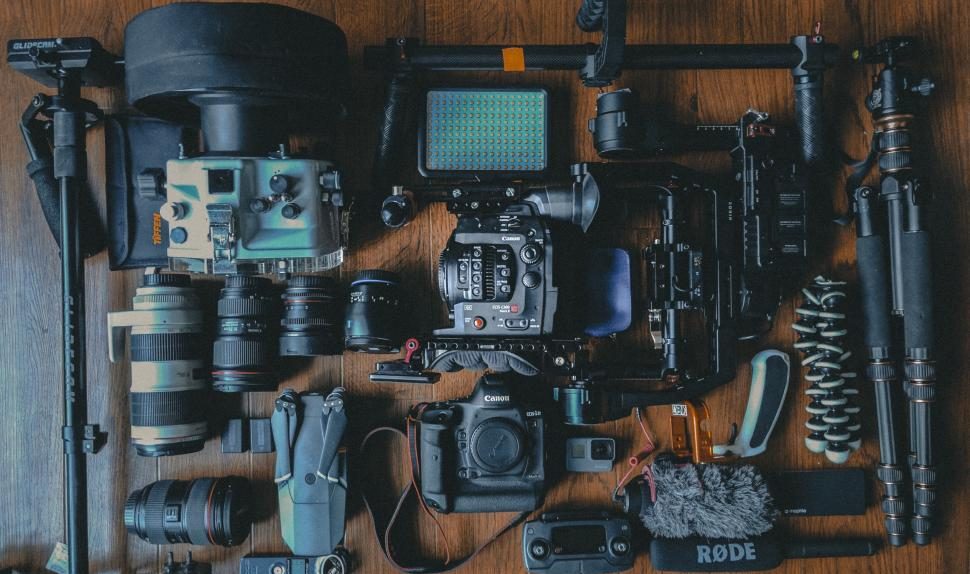
What kind of photography blog would this be, if there was no post about the gear!? (BTW: That is not my gear 😉
Before we dive into the different thingies in my bag, let’s make sure we establish the following: Tech does not replace talent.
I don’t claim to be talented. My point is that whatever little talent you have, technology is not going to save you. Tech will not inspire you or compose the photo for you. Of course, AI is now available, and you can create images without ever having to leave your desk, but that is not the kind of photography that I am pursuing.
On the other hand, photography cannot exist without a camera that captures or creates the photo. Today, for the most part, this is done electronically. So, no tech, no photography. And in the age of digital photography, we should not ignore photo editing either.
So, where do we draw the line? I don’t know. Is the Daguerreotype the only acceptable tool for true photographers? What about Autofocus, Image Stabilisation, Automated Exposure, Eye Tracking, and all the other cool features modern cameras offer? What about fidgeting with the white balance, having your AI-enabled editing software remove a few wires from a street photo, or making the model’s eyes more radiant?
If it was only about capturing a moment, then you could go with any type of pocket camera or smartphone. They all have impressive specs these days and the smartphones shine with image optimization, AI functions, multiple exposures, intelligent HDR, etc., etc., etc.
For me, these gadgets are valuable additions that reduce manual work and help me focus on what I want to capture. My camera offers a multitude of automatic options, but I enjoy fiddling with the settings myself. My RP is mostly on M for Manual, but I do use Autofocus and Image Stabilisation when available. I use different lenses, and if the day is too bright, I might slap an ND filter on my lens. I am no purist, and I like playing with the opportunities digital photo editing gives me.
I am still learning and trying out gear, and I don’t have my style yet. Maybe someday there will be a giant yard sale, and I will get rid of all the things that I found interesting at some point but ended up not needing for the kind of photos I want to make. Maybe I am just a hoarder. Who knows…
So what is in the bag?
I have the gear I most commonly use in the bag. It is a “grab bag” setup. This means I can take the bag and know I will be good to go for at least a weekend. Before, I had to pack the bag for the occasion. The result was that I would not take my gear with me unless I specifically had planned to photograph. Not having to think about it means that I have the gear with me more often.
The camera
- Canon RP* – Entry-level mirrorless camera with a full-frame sensor. Very lightweight and easy to use. 26,2 Megapixel, RF-Mount, 440g.
Lenses
- Canon RF 16mm, f2.8 STM* – Almost a so-called “Fish eye”, the ’16 offers very wide angles.
- Canon RF 35mm, f1.8 Macro IS STM* – My favorite multi-purpose lens. I use it often for portraits or when I am wandering in the city.
- Canon RF 50mm, f1.8 STM* – The so-called “standard lens”.
- Canon RF 24-240, f4-6.3 IS USM*—This is the KIT lens that came with the camera. It was initially convenient because it covered the wider angles AND some zooming. However, carrying your camera on a neckstrap with this lens is too heavy. It is part of the “grab bag” setup I mentioned before, but I find myself leaving it behind more and more, and I am considering selling it.
Other stuff in the bag
- Batteries. The RP uses the LP-E17, a smaller battery than the larger R-Series cameras. On a longer day, I might need two batteries. For a weekend trip, I carry 3 spares, plus the one in the “chamber”. The original Canon batteries go for about 45-50€, but you can get compatible batteries from other vendors for much less (e.g. Enegon. 2 batteries plus a USB charger for less than 30€*). What they lack in capacity, they make up on price.
- Canon RS-60 E3 Remote Shutter* – A great help, particularly in low-light situations. The RP supports an App for the iPhone (probably also for Android), but I find the little wired thing more practical for my use.
- ND filters from B&W in different diameters and strengths. I live in Hamburg, so I don’t have many situations where the day is too bright, but they are very helpful for long exposures in bright environments.
- Polarisation filter from B&W.
- Pocket torch (try reading anything or fiddling with your camera mount in the dark with no torch)
- Pocket screwdriver
- ARCA Swiss plate* for the camera. This is a quick mount for tripods. It is widespread on professional gear, tripods, camera cages, sports tele-lenses, etc. I equipped all my tripods with quick mounts for Arca Swiss, and I also use it on my video camera.
- Memory cards. The RP has a single slot for a fast SD card. There is always a 128GB card in the camera and one 128GB spare in the bag.
- I have a scarf in one of the pockets. It was a gift from a shop when I bought the 50mm lens. It doubles as a bandana and has been very helpful in cold, windy places when your neck or ears get very cold.
- A simple lens cleaner kit consisting of a very soft brush and bellows to remove dust.
The bag
- Tenba DNA 16 Messenger Bag* – I tried different bags and backpacks before, but this seems the most practical for me. I can attach it to the telescope handle of my travel luggage, I can stuff my laptop or iPad in it if I need to and I can access everything in it without having to put it down anywhere.
Disclaimer
*These are affiliate links from amazon.de. Should you purchase any of these articles following one of the links, amazon.de will pay me a small commission. This does not affect your price.
amazon.de pays a commission based on you following the link. My rating, positive or negative is not influenced by amazon.de
Photo by Unsplash from Freerange Stock
I was curious about that RP. Through your work, now I know it’s awesome. But then again, they say the glass is more important, but then again, the photographer is most important to create interesting images. You have some really interesting stuff. Thanks for sharing.
Hi Mark,
Thank you for the feedback on my work. As I point out in the article, the gear is meant to support your vision and then help you get the best “quality” possible. I write quality in quotes since everyone might have a different perspective on what that means. Lo-Fi is often a choice, not a limitation.
On Instagram, I have seen channels that only use smartphones but produce stunning photography.
Are you familiar with “The Big Bang Theory”-Sitcom? There is an episode in which Sheldon wants to buy a new gaming console but can’t decide which is the best. He is a nervous wreck and is close to a breakdown because there are so many options. That is how I felt when I was choosing a camera and my first lenses. At that point there was one particular thought that really helped me: Helmut Newton did some of his best work with a 35mm pocket camera with a fixed lens. Avedon, Leibovitz, and Capa never held a digital camera in their hand for the most part of their careers. There was no digital photography available to Capa, yet he produced some of the most iconic photos of the first half of the 20th century.
If these people were able to turn a piece of paper into art using basic equipment, then I should not worry at all. ANY camera will do for me. The rest is budget, ego, and personal preferences.
Tell me how it went for you and what you decided at the end.